Shared Vacation Home Ownership: The Complete Playbook
· 11 min read

Key takeaways
- A shared vacation home ownership agreement must cover four things: who gets which weeks, who pays what, who fixes what, and how anyone exits.
- Split fixed costs like taxes and insurance by ownership share, and usage-driven costs like propane and cleaning by actual use.
- Prime weeks like July 4th need a rotating draft or a points-bidding system so no family books them every year.
- Run a four-season cabin checklist (spring opening, summer checks, fall winterization, winter storm checks) and log every task with a date, name, and vendor contact.
- Before buying in, divide total annual costs by your family's actual weeks of use and compare that per-week figure against local rental rates.
Shared vacation home ownership works when you run it like two jobs: a legal one and an operational one. You need a written agreement covering costs, weeks, and buyouts, plus a working system for bookings, maintenance, and provisioning. Most guides cover one or the other; this playbook covers both, end to end.
What is shared vacation home ownership, and who is it actually for?
Shared vacation home ownership means two or more people hold title to one cabin, lake house, or condo and split both the costs and the calendar. The legal part is one document; the hard part is the running of it: who has the cabin over July 4th, who fixed the thermostat, who paid the plumber.

Photo by Hanna Lazar on Unsplash
The three common setups: family inheritance, sibling purchase, friend groups
Most co-owned cabins come from one of three places: a property inherited by siblings, a deliberate purchase by two or more family members, or a friend group buying together. Inherited homes are the most fraught, since grief and old sibling dynamics arrive with the deed; conflicts over inherited property are common enough that estate planners treat them as routine.
Who ends up doing the coordinating (and why that role burns out)
In every family, one person becomes the de facto organizer: chasing dates across group texts, maintaining the to-do list, remembering which HVAC company you used. That role has no title, no pay, and no end, and it's usually the organizer who goes looking for a fix, whether a shared agreement or a tool like Cabindar exists to formalize it.
What should a vacation home shared ownership agreement include?
A shared ownership agreement needs four things: who gets which weeks, who pays what, who fixes what, and how anyone gets out. Write it down before the first July 4th argument, not after. A shared Google Calendar and a handshake cover maybe half of it.
Usage and scheduling clauses
Set how weeks are claimed: a booking window, peak-week rules (prime ski season and Thanksgiving week usually need a rotation or lottery), guest policies, and what counts as a double-booking. Decide whether non-owning relatives can book, and how far ahead.
Money clauses: costs, reserves, and rent-out rules
Split fixed costs (taxes, insurance, utilities) by ownership share, and consumables by use. Require a cash reserve for surprises, and set rules for renting out booked weeks: who approves, how income is split, who handles cleaning.
Maintenance and improvement clauses
Define routine upkeep versus upgrades, spending thresholds that need a family vote, and who actually does each seasonal task. Name a point person per task so nothing lives only in the group chat.
Exit, buyout, and inheritance clauses
Cover right of first refusal, how a buyout gets priced, what happens on divorce or death, and whether heirs inherit the share or the obligations. Revisit the agreement every few years; families and cabins both change. Once the agreement is signed, tools like Cabindar (one person pays $39/year per cabin) handle the scheduling and to-do side; see how we handle your data.
How do co-owners split costs, usage, and scheduling fairly?
Pick one cost model and write it into the agreement, because "we'll figure it out later" is where the group chat fights start.
Splitting costs: equal shares vs. usage-based
Equal shares work when everyone owns equal stakes and uses the cabin similarly. Usage-based splits fit when one sibling books most of the prime weeks. A common hybrid: equal shares for fixed costs (taxes, insurance, snow removal) plus a per-night rate for anything usage-driven, like propane or cleaning.
Allocating prime weeks: rotation and bidding systems
July 4th and Thanksgiving week can't go to the same family every year. Two systems that hold up:
| System | How it works | Best for |
|---|---|---|
| Rotating draft | Families pick weeks in an order that flips each year | Equal owners, low drama |
| Bidding | Each family gets points to spend on weeks annually | Unequal usage or stakes |

Photo by Ryan Jacobson on Unsplash
If one family wants out entirely, buyouts typically hinge on a professional appraisal; the Appraisal Institute sets the standards appraisers follow.
Why a shared Google Calendar breaks down at 3+ households
A shared Google Calendar shows dates but not who booked them, who owes what, or whether two cousins double-booked. Once three or more households compete for booked weeks, you need bookings tied to names and rules. A tool built for this, like Cabindar, keeps the calendar, the task list, and the "who has the cabin" answer in one place.
What does a seasonal cabin maintenance checklist look like?
A cabin checklist runs on four seasons: open it in spring, do light checks in summer, winterize in fall, and watch for storm damage in winter. Assign each task a name in the family group chat so nothing waits for "someone" to notice.
Spring opening checklist
Walk the property before the first booked weeks. Turn the water back on and check for burst pipes, test smoke and CO detectors, replace HVAC filters, inspect the roof and gutters, and look for rodent evidence. Confirm the deck, dock, and steps are safe before anyone's kids are sprinting on them.

Photo by Jacob Bentzinger on Unsplash
Summer upkeep and mid-season checks
Every few weeks, mow and trim, clean the grill, flush the water heater if it's due, and check for wasp nests and small leaks under sinks. Mid-season is also when you confirm the HVAC is keeping up before peak heat.
Fall winterization checklist
Before the first hard freeze: shut off and drain the water lines, blow out pipes if needed, winterize the outdoor sinks and spigots, drain the irrigation, cover or remove AC units, clean the chimney, and seal gaps where mice get in. One missed spigot becomes a spring surprise.

Photo by Sašo Tušar on Unsplash
Winter checks and storm response
If the cabin sits empty, ask whoever is closest to check after big storms: heat is on, no alarms, no fallen limbs on the roof, driveway passable.
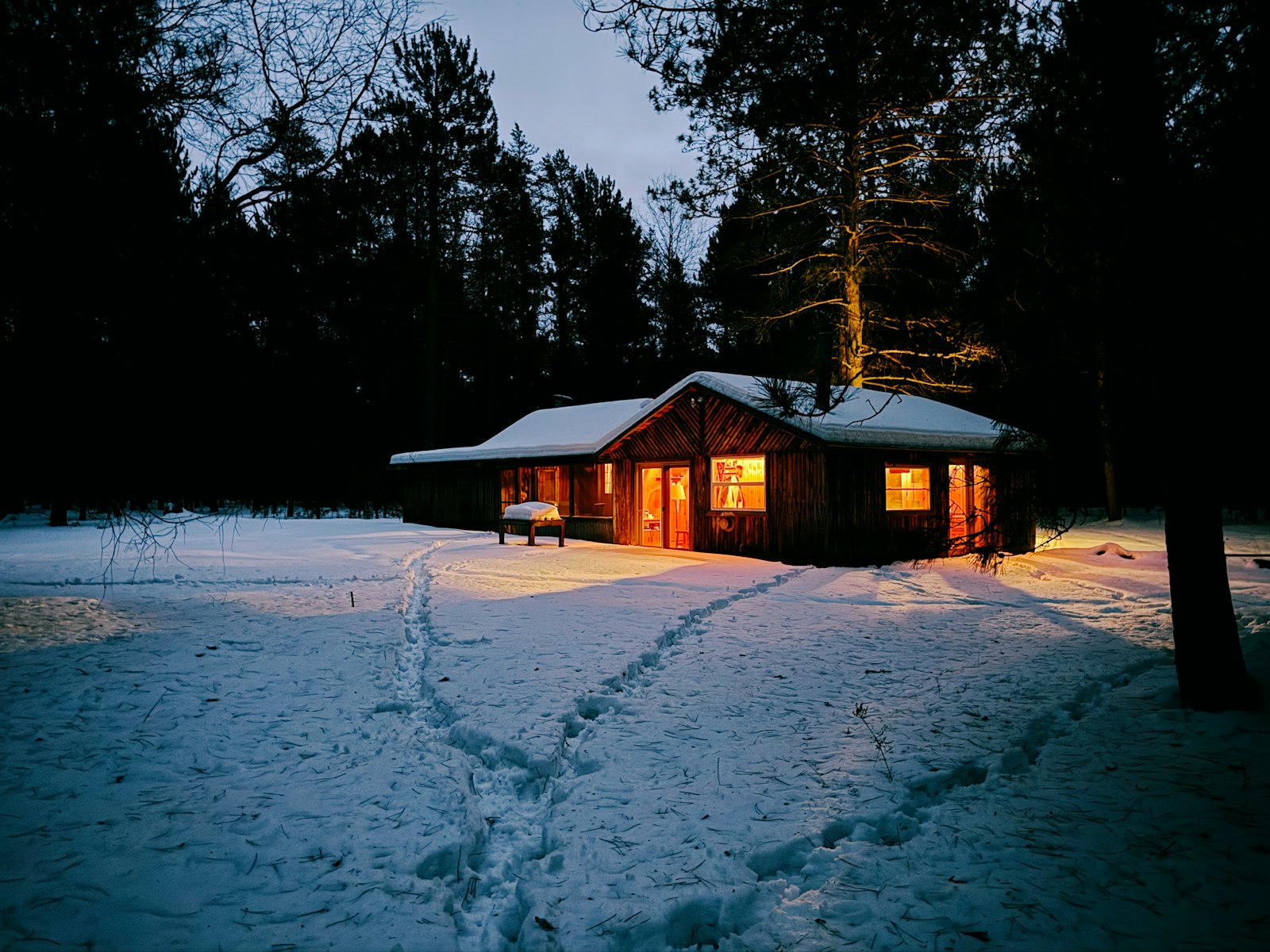
Photo by Sean C Davis on Unsplash
Tracking who did what (and keeping receipts and vendor names)
This is where most families lose the plot. Someone winterized the place two years ago, but nobody remembers who, what they used, or what the HVAC guy's name was. Write down every task with a date, a name, and the vendor contact next to it. Snap a photo of the thermostat wiring or the shut-off valve and attach it, so next year's person isn't starting from a text thread that scrolled away. A shared note works; a tool with the checklist built in works better. The point is that the answer to "what was that company we used?" lives in one place, not in one cousin's camera roll.
How do you stock a cabin without duplicating groceries across owners?
The group chat fails at provisioning because nobody knows what's already in the pantry. Two households arrive with coffee, paper towels, and ketchup; nobody brings dish soap. Fix it with three habits.

Photo by James Coleman on Unsplash
Separate staples from trip-specific groceries
Staples are things the cabin should never run out of: coffee, salt, oil, trash bags, toilet paper, sponges, matches. Trip-specific groceries are what each family eats that weekend. Only staples belong on a shared list; meals stay with whoever's hosting.
A standing staples list each arriving household checks
Keep one shared list of staples with rough quantities. Before a trip, the arriving family scans the pantry, marks what's missing, and buys only that. If you winterize in fall, add seasonal items like antifreeze for outdoor sinks to the same list, the way extension services fold seasonal prep into routine home checklists (University of Minnesota Extension).
The checkout-and-restock habit
Whoever uses the last of something marks it on the list before leaving. That thirty-second habit is what keeps the next family from discovering an empty coffee can at 7 a.m.
Which scheduling tools actually work for co-owned cabins?
Five criteria to judge any tool against
A shared Google Calendar handles dates, but not the rest of the job. Test any tool against five things: booking requests with a fair way to resolve conflicts, a maintenance and to-do list attached to the cabin, a place for vendor names and how-to notes, low friction for less-technical relatives, and pricing that does not scale painfully per person.
How Cabindar, Dwelly, OurSharedPlace, Ripazo, and NestBoard compare
Cabindar, Dwelly, OurSharedPlace, Ripazo, and NestBoard all target the same problem: co-owned cabins, bookings, and household coordination in one place instead of five group chats. Cabindar is priced at $39/year per cabin, with one family member paying and everyone else using it free. Splitwise is worth a mention for splitting shared costs, but it does not handle scheduling.
Where Cabindar falls short
Cabindar is young, so it lacks the polish and feature depth of more established tools, and it does not handle expense splitting the way Splitwise does. If your family needs payment tracking or cost reconciliation built in, pair it with Splitwise or pick a competitor that covers both. If your pain is "who has the cabin" plus the to-do list, Cabindar covers that core cheaply.
How do you handle disputes or buyouts between co-owners?
De-escalating scheduling and money disputes
Most fights start over prime weeks or unpaid shares, so fix the system, not the sibling. Set a booking deadline for July 4th and Thanksgiving week requests, and let the shared calendar, not group texts, be the record. For money, pick one fairness method and write it down: equal splits, usage-based splits, or fixed shares tied to ownership percentages. Personal finance writers recommend agreeing on the split formula before the next bill arrives, not after (Kiplinger).
Structuring a buyout without blowing up the family
A typical sibling buyout: get an appraisal or agreed valuation, then pay over time, often 3 to 5 years, with the cabin itself as security. Put it in writing, signed by everyone, and spell out what happens if a payer misses a year.
When to bring in a mediator or attorney
If two rounds of family discussion go nowhere, hire a mediator before anyone lawyers up. An attorney makes sense only once you're drafting the buyout agreement itself.
When is shared ownership a bad idea compared to just renting?
Signs your family should rent instead
If siblings already argue about who has the cabin during July 4th or Thanksgiving week, ownership will amplify that, not fix it. Ditto if one family uses the place most of the summer while others pay half. Renting a comparable cabin for your booked weeks costs more per night, but nobody inherits a roof replacement or a flaking thermostat.
The math to run before buying in
Before buying in, estimate annual costs: mortgage, taxes, insurance, utilities, maintenance, and a reserve fund for the surprise repairs. Divide by your family's actual weeks of use, not the weeks you wish you'd use. Compare that per-week figure against local rental rates for the same weeks. If renting wins, rent.
FAQ
How many families can realistically share one vacation home before it stops working?
Two to four households is the practical range. Below three, the calendar rarely conflicts; above four or five, prime weeks like July 4th get contested from every direction, cost collection gets slow, and decisions need a formal voting structure. A shared Google Calendar breaks down around three households, so larger groups need named bookings and written rules from day one.
Do we need a lawyer to write a vacation home shared ownership agreement, or can we use a template?
A template covers the four core sections: weeks, money, maintenance, and exit terms. A lawyer earns their fee on the exit and inheritance clauses, especially for inherited property, divorce scenarios, and state-specific title rules. A reasonable middle path: draft with a template, then pay an attorney for a one-hour review before anyone signs.
What happens if one sibling wants out but the others want to keep the cabin?
A typical buyout starts with a professional appraisal or an agreed valuation, then the remaining owners pay the departing share over time, often across 3 to 5 years, with the cabin itself as security. Get it in writing, signed by everyone, and spell out what happens if a payer misses a year.
Should we rent out our shared cabin weeks we don't use, and how do we split that income?
Renting idle weeks offsets taxes, insurance, and maintenance, which helps families who use the cabin fewer weeks than they pay for. Write the rules into your agreement before the first listing: who approves a rental, how income splits (usually by ownership share), and who handles cleaning and key handoff. Unwritten rental rules are a reliable source of disputes.
How do we keep maintenance records, vendor contacts, and how-to videos in one place instead of scattered group texts?
Log every task with a date, the person who did it, and the vendor contact next to it. Photograph the furnace label, shut-off valve, or thermostat wiring and attach it, so next year's person isn't reconstructing a scrolled-away text thread. A shared note works; a tool with the checklist, bookings, and vendor names attached to the cabin works better.
Cover photo by Bruno van der Kraan on Unsplash